
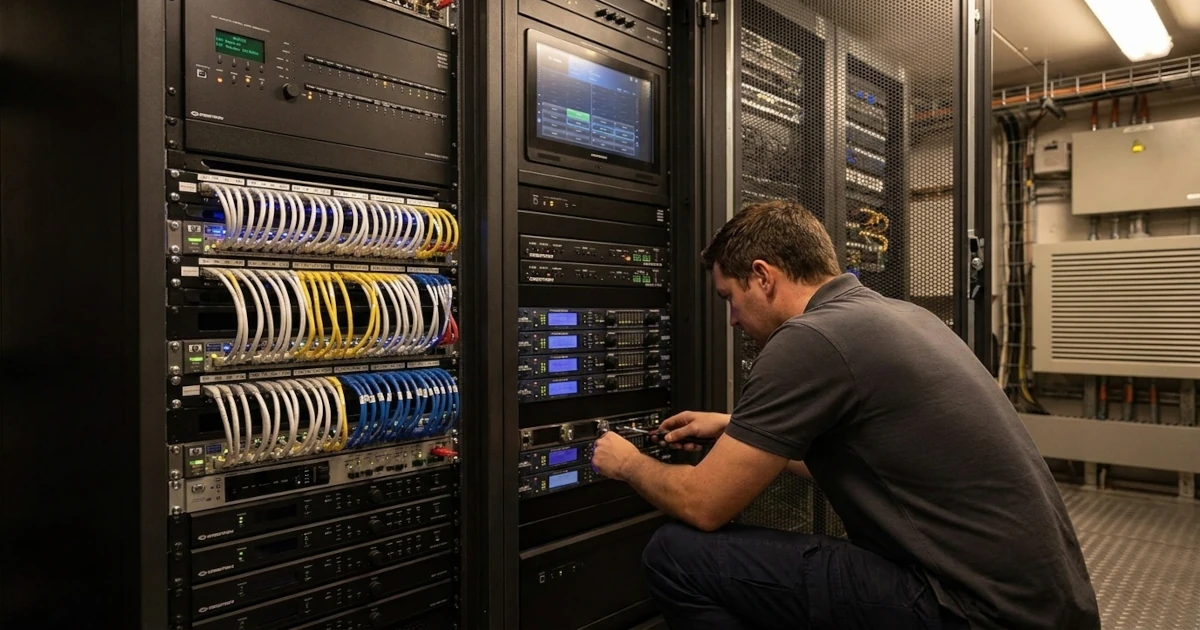
When people find out you work on yachts, the reaction is always some version of lucky you, that must be interesting. Nobody asks what the work actually is.
For an AV/IT Officer it looks like this. You wake at five, because the guests are asleep and that is the only hour of the day you can touch anything. You walk every saloon and every cabin, switch on each television, and check that the Apple TV has not frozen overnight and that no subscription has quietly expired. You check every access point is online. You check the AirPort Expresses are discoverable, because if a guest opens Spotify at nine and the saloon does not appear in the list, that is your morning gone. You finish this round before eight, which is when your working day officially begins.
You go to bed when the last guest does. With a young charter group that is two or three in the morning, and on some of those nights you are not fixing anything. You are running the karaoke, pulling backing tracks off YouTube and handing out microphones. Then at the end of the trip you cut the photos and clips you have been taking all week into a five to nine minute film, render it, and hand every guest a USB stick on the way off.
Almost none of that appears on a typical AV/IT CV. That is what this page is about.
The two things a chief engineer checks before anything else
Long before anyone reads a word about Crestron, they look at how long you have been in yachting and how long you stay.
A CV showing a new boat every four months gets put down. It does not matter how strong the systems knowledge is. Setting rotation aside, the expectation is around a year on a vessel, and a run of shorter contracts reads as either someone who leaves or someone who gets asked to leave. On a boat with exactly one technical person, both are expensive.
Most people have short stints somewhere. Give the reason in four words and the problem disappears. Boat sold. Owner change. Yard period finished. Silence invites the worse assumption and nobody is going to call to ask.
The second thing is whether the CV has the information a yacht CV needs at all. A lot of them come out of generic online builders that have no field for rotation, flag, vessel length, tickets or visas, so all of it ends up crammed into a paragraph or missing entirely. A captain skimming twenty applications on a phone is not going to dig for it.
Decide which tier you are writing for
Yachts over 100 metres generally carry a dedicated AV/IT Officer and a dedicated ETO as separate crew, both under the chief engineer. From around 70 metres the norm is one person covering both. Below that, AV/IT gets absorbed into engineering entirely.
This changes the whole document. For 60 to 80 metres you are proving range. For 100 metres plus as a specialist you are proving depth. A CV that tries to do both reads as unfocused to both readers.
The 60 to 80 metre bracket is also where most of the work is. There are far more boats that size, and the dual role is harder to fill because it wants someone comfortable in two disciplines that are normally taught separately. If you have both, build the CV around it instead of apologising for it.
Name the systems, and be honest about the level
"Experienced with onboard AV systems" tells a chief engineer nothing. He has read that line hundreds of times.
Crestron appears in more adverts than anything else, with Savant and Control4 turning up on smaller boats. Say which processors you have worked with and whether you can edit a program or need the integrator, because that is a real dividing line and it will come out in the phone interview anyway.
For audio, Q-SYS, BSS Soundweb, Dante and Symetrix. Configuring a Dante network is a different skill from plugging into one, so say which. For video, Kaleidescape, matrix switchers, projector and screen systems, and the tender and beach club setups nobody ever documents properly.
Networking is where a lot of AV people are thin and where you can separate yourself. VLANs, managed switches, firewall rules, whatever the boat runs. If you have rebuilt a guest network from scratch, that is worth a line on its own. Same for connectivity: VSAT, Starlink, and the failover between them. Owners now expect shoreside internet at anchor and this generates more complaints than everything else combined.
Write these inside your experience entries as evidence, not as a wall of logos in a skills box. "Rebuilt guest and crew traffic onto separate VLANs after repeated dropouts, no guest complaints the following two seasons" is worth more than the word networking sitting in a list.
What these systems are actually built on
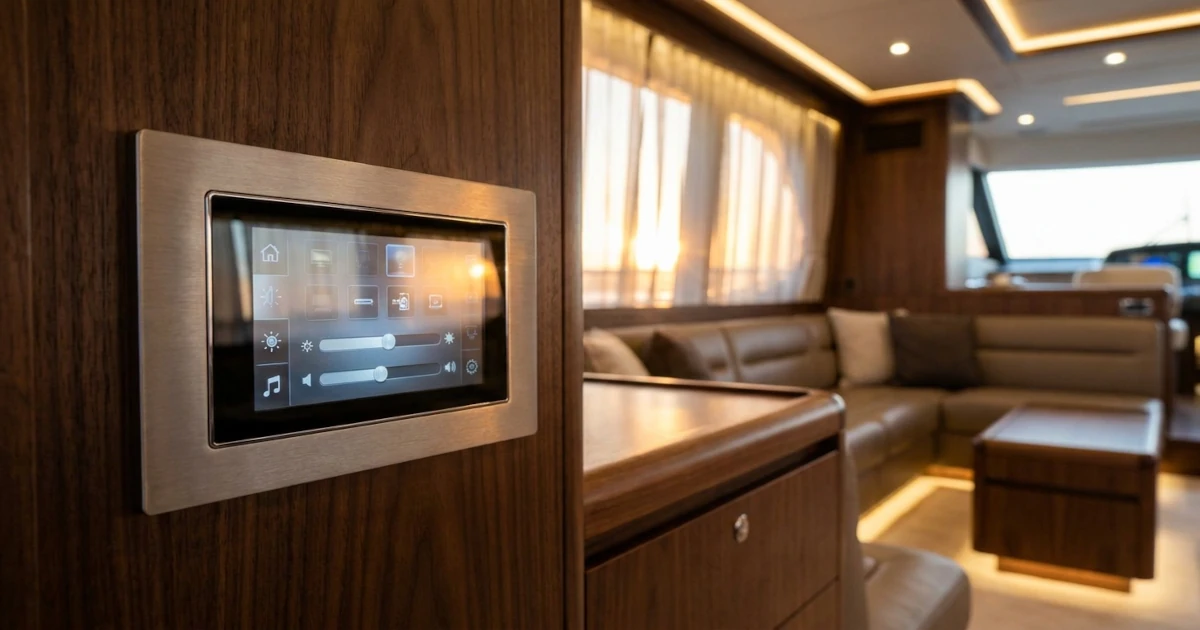
Here is something the job adverts leave out. A yacht worth fifty or eighty million dollars will be running the entire guest audio through consumer streaming boxes that were current a decade ago. They drop connections. They refuse to accept a phone pairing. They go missing from the Spotify list halfway through dinner while twelve people are sitting at the table.
That is the real job. Not the beautiful control system in the brochure, but the ageing consumer hardware quietly holding up the guest experience, and knowing which piece of it is about to fail.
I travelled with my own Android box in the case for years for the same reason, because you never know what you are joining until you are aboard. That habit is worth more than most certificates and it is the kind of thing that never makes it onto a CV.
Solving things in an hour with no official route
A guest joins in the afternoon and wants a specific game from home on in the main saloon in two hours. He does not care that the rights are geo-locked to another continent, that the official service will not sell to a card registered in Europe, or that the boat is at anchor on a satellite link. Not available in your region is not an answer anyone on board will accept.
What saves you is not the manual. It is knowing the matrix well enough to bring a new source in on a spare input without disturbing anything the guests are already using, having the hardware with you, and having thought about the problem before it landed on you at four in the afternoon.
This is the single most valuable thing you can communicate on an AV/IT CV, and it is the hardest to phrase. Do not write that you are a problem solver. Give one concrete example with the constraint in it: what the guest wanted, how long you had, and what you did. One line is enough.
The half of the job nobody writes down
AV/IT is one of very few technical positions with direct guest contact. When the owner's film will not play at eleven at night you are the one standing in the saloon, and how you handle that minute matters as much as the fix.
It goes further than that on charter. You end up running the entertainment, setting up karaoke for a group half your age, and being sociable at two in the morning when you started at five. On a lot of boats you are also the one filming and photographing the trip, then editing and rendering the guest video at the end of it.
If you have done any of this, put it on the page. Video editing, photography, guest entertainment, training the interior team to use the systems. Most CVs in this category leave all of it out, which makes it cheap to include and easy to stand out with. A captain reading it immediately understands that you can be in front of guests without being managed.
The engineering half, if you have it
For the dual role this is what gets you shortlisted.
A chief engineer hiring one technical person for a 70 metre boat is working out how much of his own week you are going to consume. If the CV shows you can trace a fault on a distribution board and read a schematic, he stops worrying. If it shows only AV, he assumes he is inheriting an extra job.
Say plainly what electrical work you have done. Switchboards, generators, motor controls, lighting circuits. If you hold STCW III/6 as an Electro-Technical Officer, put it high on the page, because it settles the question in one line. List high voltage training separately, since they are different things and captains know it.
If you came from shore side integration or offshore rather than up through yachting, do not hide it. A rack built in a plant room and a rack built in a lazarette are not the same job, but the discipline transfers and time in an environment where downtime cost real money reads well. Just translate it into yacht terms rather than leaving the reader to do it.
Certificates
The mandatory list is short. STCW Basic Safety Training and a valid ENG1 or equivalent seafarer medical. Both are hard filters on almost every advert, so put the expiry dates on and keep them current.
After that it is looser. There is no mandatory certificate of competency for AV/IT the way there is for deck and engineering. An industry working group involving SYBAss, MYBA, the PYA and IAMI has been building a qualification framework, and training providers have started aligning to it, but nothing yet carries the legal weight of an STCW ticket.
In practice that means manufacturer and industry courses count for more than they would in a regulated role. The Crestron Superyacht Systems Technician certification, delivered through the yacht specific AV courses run in the UK and Europe, shows up often enough in adverts to be worth having. Q-SYS, Dante and Cisco certifications do the same for their areas.
List them with the awarding body and the year. A certificate from 2014 with nothing since reads differently than one from last winter, and the reader will notice whether or not you make it easy.
Vessel detail, not just names
Every position needs the same skeleton: length, type, flag, private or charter, crew number, rotation. A 68 metre charter boat doing twenty weeks a season is a completely different job from a 68 metre private boat that moves twice a year, and nobody can tell them apart from the name.
For AV/IT, add whether you joined during a build or refit. Yard time means you saw the systems installed and commissioned instead of inheriting a black box, and it usually comes with documentation habits, both of which matter to a chief engineer.
What to cut
Consumer IT support unrelated to boats. Expired certificates. A skills section listing every acronym you have ever met. Duties copied out of a job description. Keep it to one page if you can, two at most.
The test before you send it
Read it as the person hiring. If you cannot answer "can this person keep the guest systems running, handle the owner directly, and still be useful in the engine room" inside thirty seconds, it is not finished.
The AV/IT job on a mid size yacht is a trust position. The owner's experience of the entire boat runs through systems you are solely responsible for, usually with nobody aboard who can check your work. The only real job of the CV is to make somebody believe you can carry that alone.