
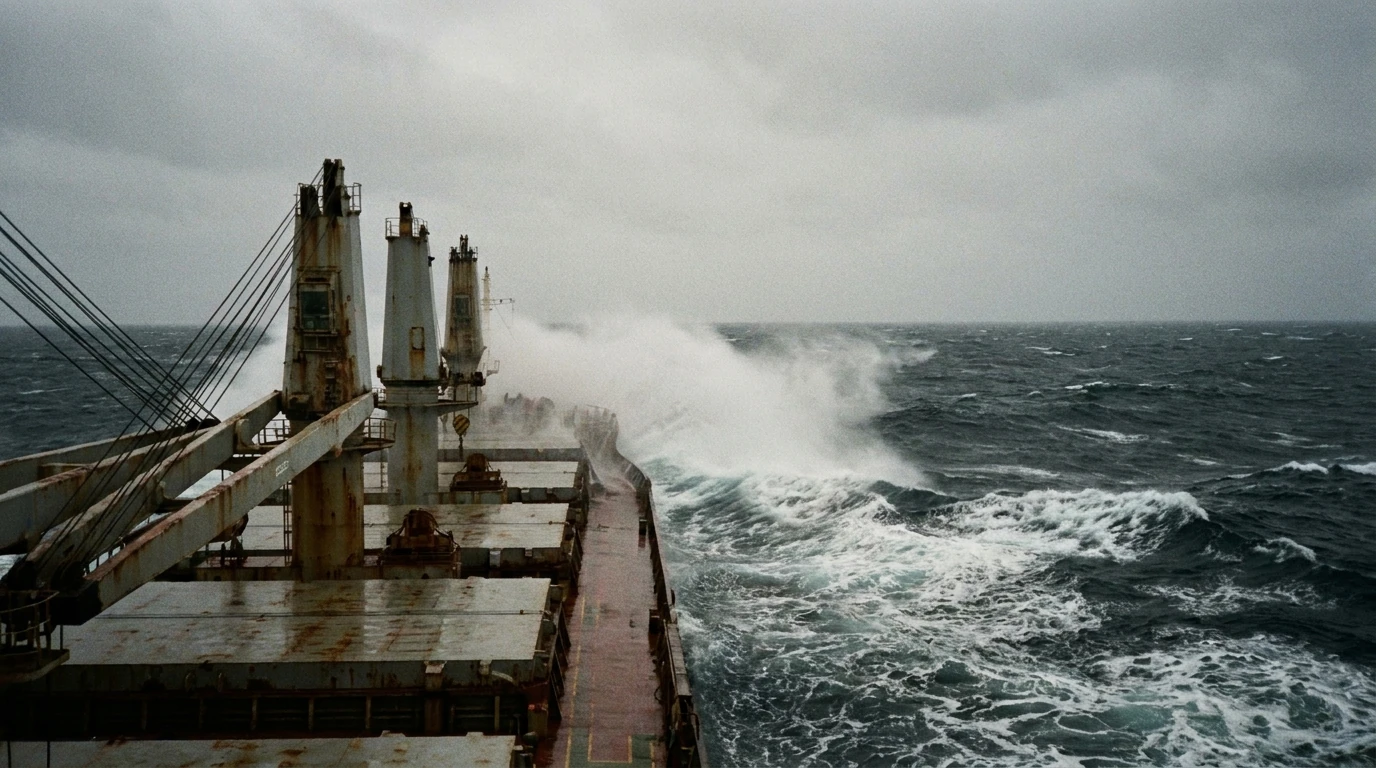
I was twenty one years old the first time I signed on a ship. It was 1996, the ship was the Sava, she belonged to Croatia Line, and the first voyage was across the Atlantic to New York. I went on board as an electrician. The contract was seven months and fifteen days.
It was not easy. I will not pretend otherwise. But I got through it, and I have always believed I had some help from above.
We tied up in Brooklyn, at Red Hook, and we stayed there for a month. That was lucky. I had only ever seen New York on television, and suddenly I was walking around Manhattan with my own two feet. I still remember that feeling. A kid from Croatia, standing in the middle of it.
Calling home worked differently back then. When you came into port, the first thing you did was find a shop and buy a phone card for twenty dollars. Then you looked for a payphone. Twenty dollars bought you about ten minutes. You said what mattered and you hung up, because that was all you had until the next port.
What the job actually was
People hear "electrician on a ship" and think of light bulbs and fuse boxes. It was nothing like that.
The engine room team was the Chief Engineer, First, Second and Third Engineer, a mechanic, me as the ETO, and an oiler. My side of it was every electrical and electronic device in the engine room, plus all of the navigation equipment on the bridge. On deck we had four Hägglunds cranes, half electric and half hydraulic. When one of them went down, the mechanic and I worked on it together. And when he could not manage something on his own, I welded. You do what needs doing, because there is nobody else coming.
Crossing the Atlantic took around twenty days. We ran into bad weather often enough. When it got really rough there was no point pretending I could work, because I could not hold anything steady and I could not do the job properly. So I went to my cabin and waited for the sea to calm down. That is a strange kind of patience to learn at twenty one, lying in a bunk in the middle of an ocean, waiting for the weather to decide when your day starts again.
Offshore
After the cargo ships I moved to offshore. I worked as an Electronic Technician on a 150 metre pipelay vessel, first off Angola, then off Brazil, and other places after that. I spent five or six years out there.
Offshore is a different world again. The vessels are enormous. Diesel generators putting out twenty five megawatts in total. Because of the DP3 class, the engine room is split into two separate compartments, and so is the switchboard, so that a fire or a flood in one half cannot take the whole ship down. Everything is built around redundancy.
The other thing about offshore is where it takes you. Angola, Nigeria, places that are not always safe. Malaria. Ebola outbreaks in the region. You go, you do the work, you come home.
Then I stopped. I had saved money, so I opened a computer shop with a service department and ran it for ten years. I got married in that time. After ten years I closed the shop and went back offshore, to Angola again, then Singapore.
How I ended up on yachts
I came to yachting on a recommendation. That is how most of it works. The job was on Wedge Too, a 64 metre yacht based in Monaco, and that was the start of my yachting years.
The technical difference hit me first. I had come from a vessel with twenty five megawatts of generating capacity and a DP3 split engine room, and now I was on a yacht running two Caterpillar sixteen cylinder engines at just over two thousand horsepower each. On paper it looked simple compared to what I was used to.
The life, though, was better. That is the honest truth. Offshore you are in Angola or Nigeria. On the yacht I finished at five in the afternoon in Monaco and went for a walk among people. After years of the other thing, that is not a small difference.
But the work was not simpler, it was different. There was a whole category of equipment I had never touched offshore, because offshore has no reason to have it. Audio, video and IT systems built for guests. And with that came something no offshore vessel has at all: a relationship with the owner and the guests themselves.
Offshore, nobody is standing over you while you fix something. On a yacht, they are.
The most stressful day I ever had
The owner of one of the yachts was a billionaire, a man with large corporations across America. One day he called me because the Kaleidescape in his cabin was not working.
I assumed he would be out of the room by the time I got there. He was not. He was sitting in an armchair with the remote in his hand, waiting for me to fix his television.
All the equipment sat inside the desk in front of him, split between the left and right sides, with the television on top. The access was tight. I had to get down on the floor, crawl underneath the desk and work my way around to the back of the units to reach the connections. And the whole time he was sitting there behind me, waiting.
It took about twenty minutes. When it came back on, I said goodbye politely. He nodded. I walked out of that cabin soaked in sweat and red in the face.
I have been in engine rooms in heavy weather and I have worked in places where you take malaria tablets every day. That twenty minutes under a desk in his cabin is the one I remember as the most stressful day of my yachting career.
A normal day when the owner is on board
If the owner gets up at eight, my day starts at six.
Every morning I walked through all the areas where he and his wife would spend their morning and I checked everything. All of the television systems. Every one of his channels, one by one. Some televisions I set to specific channels for the owner's wife, because she liked walking into a room and finding the news already on. Then the internet: are the access points up, is the speed where it should be, is anything dropping.
After that I printed his daily newspapers from his home country. He was older and he had no interest in reading news on a tablet. He wanted paper in his hands.
Then I changed, had breakfast, and started my official working day at eight.
He owned racehorses. When they were racing, I recorded the races off the television and transferred them onto the Kaleidescape, so that when he came back from his walk he could sit down and watch how his horses had done.
And because there is only one ETO on board, there is nobody to hand over to. I could not go to bed when I wanted, around eight in the evening like a normal person. I waited until a stewardess came to tell me the owner and his wife had gone to sleep. Then I could go too. And the next morning at six, the same round of checks, so that everything was working before they woke up.
Charter is another level
On charter yachts there was even more to it.
I was still the only person on board doing that job, so the same rule applied: I could not go to sleep until the last guest did, because you never know when a channel is going to drop and need fixing right then. Up at six, and if the guests were younger and there was a party, sometimes not to bed until two or three in the morning. For the whole charter.
On top of the technical work, I filmed the guests. Enjoying themselves on deck, in the water, all week. Then I edited it into a final video that was shown in the main salon on their last evening, and handed to them on a USB stick as a souvenir. I also ran the karaoke, set up the system and played whatever songs they asked for.
One of the guests owned an American rugby team. An hour before the match, he wanted to watch his team play. We were in Europe. The American rights holder blocks viewing from Europe. So I had minutes to get a VPN configured and find a way to get the feed on screen. Then he decided he wanted to watch it in the main salon instead, so I ran down to the main rack, connected an Android box to the matrix and pushed the signal through to the salon. That is how it goes. They tell you at the last minute and you get thrown straight into the fire.
Some days it had nothing to do with electronics at all. In the Caribbean once, they asked me to go and move two Mini Morris cars and get them ready for the guests to use on the island. So off I went. You are the ETO, but you are also whoever is free.

The part nobody photographs
My favourite part of the job came after the guests left.
Every charter brings a good tip for the crew. When it was over, the Captain would take the whole crew out for lunch somewhere decent. That was the best part of it for me. Everyone sitting down together, no radios, nobody waiting on anything, recharging the batteries before the next charter started.
That is the part people never see in the photographs of yachts.
One thing I never got past
There is something else I want to say honestly, because it is my experience and I stood in it.
After Wedge Too I stayed three years, then moved on to other yachts, again by recommendation. Several times, agencies were looking for ETOs for yachts over 110 metres. Those vessels had large diesel plants and serious DP propulsion, exactly the equipment I had spent years working on offshore. On paper I was the right fit.
I never got those jobs. I am convinced the reason was that I am Croatian and not English. I cannot prove it, and I am not going to try. I am only telling you what I lived through, because I think it matters that somebody says it out loud.
Looking back
From a cargo ship crossing the Atlantic in 1996, standing in a payphone booth in Brooklyn with a twenty dollar card, to a bedroom in Monaco fixing a movie server for a billionaire who was watching me do it.
The equipment changed completely. The job never really did. You are the person on board who has to make it work, usually alone, usually now.
If you are doing this job, or you want to, I hope some of this sounded familiar.
I built dajCV because after thirty years at sea I know what a yacht CV needs to say and what it does not. If you are putting yours together, it was made by someone who has been on the other side of that email.