
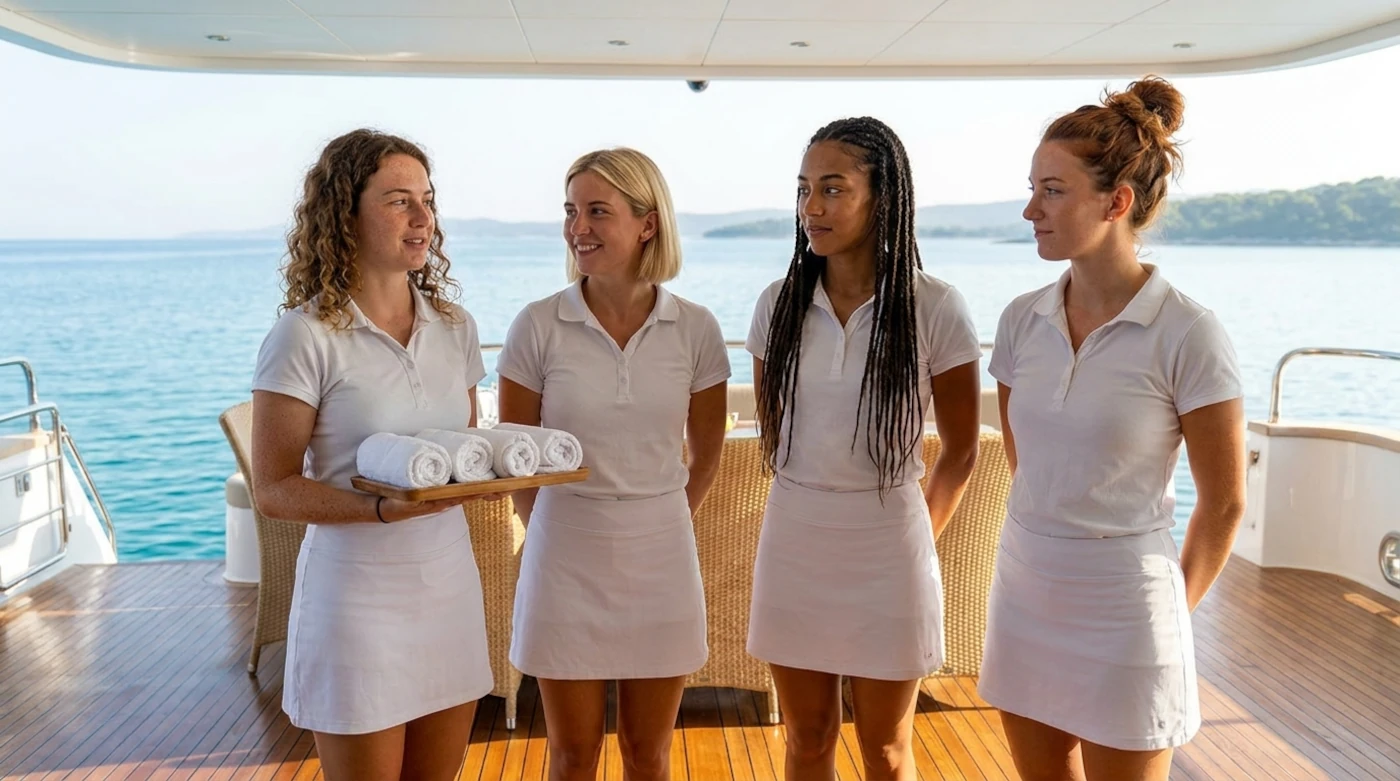
Most stewardess applications go to a crew agency, and most people writing one picture a captain reading it. That is not what happens. On almost every boat, the first person to open your CV is the Chief Stewardess, and she is reading for something quite specific.
I spent thirty years at sea, most of it as ETO on 60 to 90 metre motor yachts. Interior was never my department. But I was the one they called when a tablet in a guest cabin stopped talking to the system at eight in the evening, and I was the one setting up the karaoke rig for theme night, so I spent three decades watching the interior work at close range without ever being part of it. What follows is what a boat notices, not what a crew agency brochure says.
Who reads it, and in what order
Interior on a yacht runs Chief Stewardess, then Second Stewardess, then stewardesses. When a position opens, the agency sends a stack of CVs and the Chief Stew goes through them first. She shortlists, she talks it over with the captain, and then she runs video interviews herself. Her impressions go back to the captain, and between the two of them they decide who gets flown out.
So the person deciding whether your CV survives the first cut has done your job, probably recently. That has consequences for how you write. Language that sounds impressive but vague reads as inexperience to someone who knows exactly what a turnaround involves. Plain description of what you actually did lands better every time.
The extra skill is the real differentiator
Boats hire for what they need that season, and the need is often something that has nothing to do with service.
Hairdressing and massage are the two I saw come up most, particularly with a certificate behind them. Yoga is asked for. Dive instruction is asked for. If the owner's family is on board for six weeks and someone can cut hair properly, that is worth something no interior course can match.
This is the closest thing to leverage a new stewardess has. Everyone applying has the same basic training, and past a certain point stacking up more of it does nothing. One genuine skill from your life before yachting will change which CV gets pulled out of the pile.
Put it on the page plainly, with the certificate and where you did it. Not as a line in a hobbies section at the bottom. If you were a hairdresser for three years, that is not a hobby, it is a reason to hire you.

What the season actually looks like
When guests are on board, interior works in shifts. One team is on, the other is resting in cabins, and it rotates. That is a real difference from some other roles on board, and it is what makes a seven day charter survivable.
Everyone on service carries a radio on their belt and an earpiece. What comes through it all day is the Second Stew and the Chief Stew directing the floor. Which drink, where, to whom, who is coming down for breakfast, who is still asleep. The whole service runs on that channel, and a stewardess who cannot keep up with it is visible immediately.
Then there is the part nobody puts on a CV properly. On a seven day charter the Chief Stew plans the week, and with children on board that often means theme nights. Pirate night, with the interior in costume through dinner, the table dressed for it, a treasure hunt and riddles for the kids. Karaoke the following evening. Barbecue on the aft swim platform with the chef, service on the aft deck. That is production work, planned days in advance and executed while everything else still has to happen on schedule.
If you have done any of it, write it down in those words. Theme night planning and execution, guest entertainment for children, service on deck and platform. It tells a Chief Stew something specific about what you can be handed.
The laundry
The part nobody mentions is the laundry, and it runs every day whether guests are aboard or not.
It is usually a small room on the lower deck, three metres by three, often with no window. Guest clothing and crew clothing go through the same machines. Guest clothing is ironed. Crew clothing is not, unless someone asks the person working down there to press a shirt because they are going out that evening. It is steady, repetitive work, and most people put music on and get through the day.
Two things are worth knowing before you sign. It is monotonous in a way that is hard to picture from outside, and for a young person used to being around other people it is the hardest adjustment on board. And it is not always a rotation. On some boats it becomes one person's permanent post for a whole season, or longer, while the rest of the interior works the floor and sees guests. Nobody says that at the interview.
That is not a reason to avoid the job. It is a reason to ask, at the interview, how the interior divides laundry, and to listen carefully to the answer.
Charter boats, private boats, and why crew choose
Interior crew mostly want charter boats, and the reason is tips.
On a charter yacht a share of what is left at the end of a week is split among the crew. For a good seven days with generous guests that can be two to four thousand euros a head, sometimes more. It is harder work, because new guests keep arriving and the boat resets constantly, but the money is what pulls people into yachting and keeps them there.
A private boat with only the owner aboard is a quieter season with none of that. Both are legitimate, and it is worth knowing which one you are applying to before you take it.
Two things people are not told
The crossing. On a dual season boat, Mediterranean in summer and Caribbean in winter, there is an ocean crossing around New Year. The sea is not always kind. I watched more than one stewardess spend those days in her cabin unable to work, and these are young women who have never done anything like it. It passes, and when the boat reaches the Caribbean it is forgotten. But nobody mentions it at the interview.
The yard period. When the yacht goes into a shipyard the crew is roughly halved. Interior might keep the Chief Stew, the Second Stew and perhaps two stewardesses. The rest are let go, and a new selection runs about a month before the yard period ends. If you join in spring, understand that autumn is a decision point, not a formality.
How contracts actually end
This is the part I would want to know if I were starting.
When a stewardess is let go, she is often not told to her face. She goes home at the end of the season expecting to come back, and a few days later an official email arrives thanking her and explaining that the contract will not be renewed.
The two reasons I saw were consistent. Either something happened ashore, usually drink, and it reached the captain. Or she and the Chief Stew did not get on.
That second one is worth sitting with. Promotion works the same way in reverse. When a Second Stew position opens, it usually goes to a stewardess already on board who has been there a year or so and has shown herself. But being good at the work is not the whole of it. Being on genuinely good terms with the Chief Stew matters, and sometimes it matters more. That is not how it should be. It is how it is, and knowing it before you arrive is better than learning it in October.
Who this job is for
Most stewardesses are between twenty two and twenty eight and most arrive with no yacht experience at all. That is normal and expected. Nobody assumes you know how to run a cabin service to superyacht standard on day one.
What they assume is that you turn up, that you listen to the Second Stew and the Chief Stew, and that you hold together on day five of a charter when everyone is tired. That is the whole requirement, and it is worth writing your CV to support it. Two years in the same job ashore says it. Any work where you handled guests, money or other people's children says it. A reference from someone who will actually answer the phone says it loudest.
The certificates
You need STCW basic training before anyone can employ you, and a valid seafarer medical, which most people call the ENG1. There is a good chance you do not need the British one specifically.
Interior courses exist and some are worth doing, but do not stack them up hoping they substitute for experience. They do not, and a Chief Stew reading your CV knows exactly how much a week long course teaches.
If the boat winters in Florida or the Caribbean, you will need a US B1/B2 visa, and you cannot arrange one before you have the job. It comes with the boat, not before it.
Put every certificate on the CV with its expiry date visible. A missing date reads as careless or as something being hidden.
Practical points for the CV itself
One page. There is no second page, and needing one is not a good sign at this level.
Include a normal, current photograph. Yachting expects it.
Put your nationality, visas and availability where they can be seen without scrolling. A Chief Stew filling a gap before a charter in three weeks is checking whether you can legally travel before she reads a word about your experience.
Be honest about having no sea time. Write what you have done and let it stand. Padding is obvious to anyone who reads these all season, and it costs you more than the gap it was hiding.
If you have looked at deck as well, the same principles apply in a different department and the deckhand route is worth understanding before you choose.
The bottom line
Your CV is read by someone who has done the job, so write it for her. Say plainly what you have done, put your certificates and dates where she can find them in ten seconds, and give real weight to whatever skill you are bringing from your life before this one. That skill is what makes you the CV she remembers.
dajCV builds a one page yacht CV in the format crew agencies expect, with certificates, visas and availability laid out where a Chief Stewardess looks for them first, so the parts that get you the interview are not the parts that get buried.